We did it! On James Robertson’s birthday, David Buck and I released episode one of “Smalltalk Reflections”, a podcast about Smalltalk. Our first episode is a tribute to James, who started the previous incarnation of the show. It’s hosted by David and myself, and features remembrances from several friends and co-workers, as well as a few choice words from the man himself. I edited it, and wrote the theme music. Enjoy!
Archive for the Spoon Category
the Smalltalk Reflections podcast, episode one: a tribute to James Robertson
Posted in Appsterdam, consulting, Smalltalk, Spoon with tags podcast, smalltalk, smalltalk reflections on 2 December 2014 by Craig Lattadebugging remote exceptions works
Posted in consulting, Context, Smalltalk, Spoon with tags context, debugging, livecoding, remote messaging, smalltalk, spoon, squeak on 20 November 2014 by Craig Latta
a debugger for a remote unhandled exception
I have debugging working for remote unhandled exceptions. My motivating use case was debugging messages not understood by the Context console’s embedded web server. The console is a headless app. In development, I run it with a remote-messaging connection to a headful system. Now, when there is an unhandled exception (like a message not understood), the exception requests that the headful system open a debugger (as its default action).
Before opening the debugger, the headful system replaces the sender of the first relevant context on the headless system with the last relevant context on the headful system, hiding all the remote-messaging-related contexts in between. The picture above shows an example of this. On the headful system, I sent “zork” to an object on the headless system. The debugger shows a continuous context stack which spans the two systems. This all works with little special handling in the debugger because of the complete transparency of remote messaging. It doesn’t matter that the contexts and methods that the debugger is manipulating happen to be remote.
the IDE app README
Posted in consulting, Context, Naiad, Smalltalk, Spoon with tags smalltalk, spoon on 27 October 2014 by Craig LattaHere’s the current README for the IDE app. And oh yes, I’m considering renaming the project from “Spoon” to “Context”.

I’m available for work.
Posted in Appsterdam, consulting, GLASS, Naiad, Seaside, Smalltalk, Spoon with tags consulting, craig latta, cv, employee, resume, work on 17 February 2014 by Craig LattaHey there, it’s my semi-regular reminder that I’m available for work. Consultant or employee, I’m comfortable as either. Check out my résumé. Thanks!
current design for Context’s virtual filesystem
Posted in consulting, Context, Naiad, Smalltalk, Spoon with tags context, favorite text editor, smalltalk, spoon, squeak, virtual filesystem on 13 January 2014 by Craig LattaI’m writing Context’s virtual filesystem support now. The directory structure looks like this:
--
root
   classes
      <each class>
         methods
            all
               <each method>
                  literals
                     <literal objects>
                  source
                  version
            inherited
               <inherited methods>
            local
               <locally-defined methods>
         slots
            all
               <each slot>
                  <instances ordered by slot>
                     references
                        <referring objects>
                     slots
                        <etc>
            inherited
               <etc>
            local
               <etc>
   processes
      <each process' suspended context>
         method
            instructions
            literals
               <literal objects>
         sender
            <etc>
   README.html
--
What do you think?
the initial Context webpage
Posted in consulting, Context, Naiad, Smalltalk, Spoon with tags context, modules, naiad, smalltalk, spoon, squeak, web browser, welcome on 10 January 2014 by Craig LattaHere’s what you currently see in a web browser when you start a Context system:
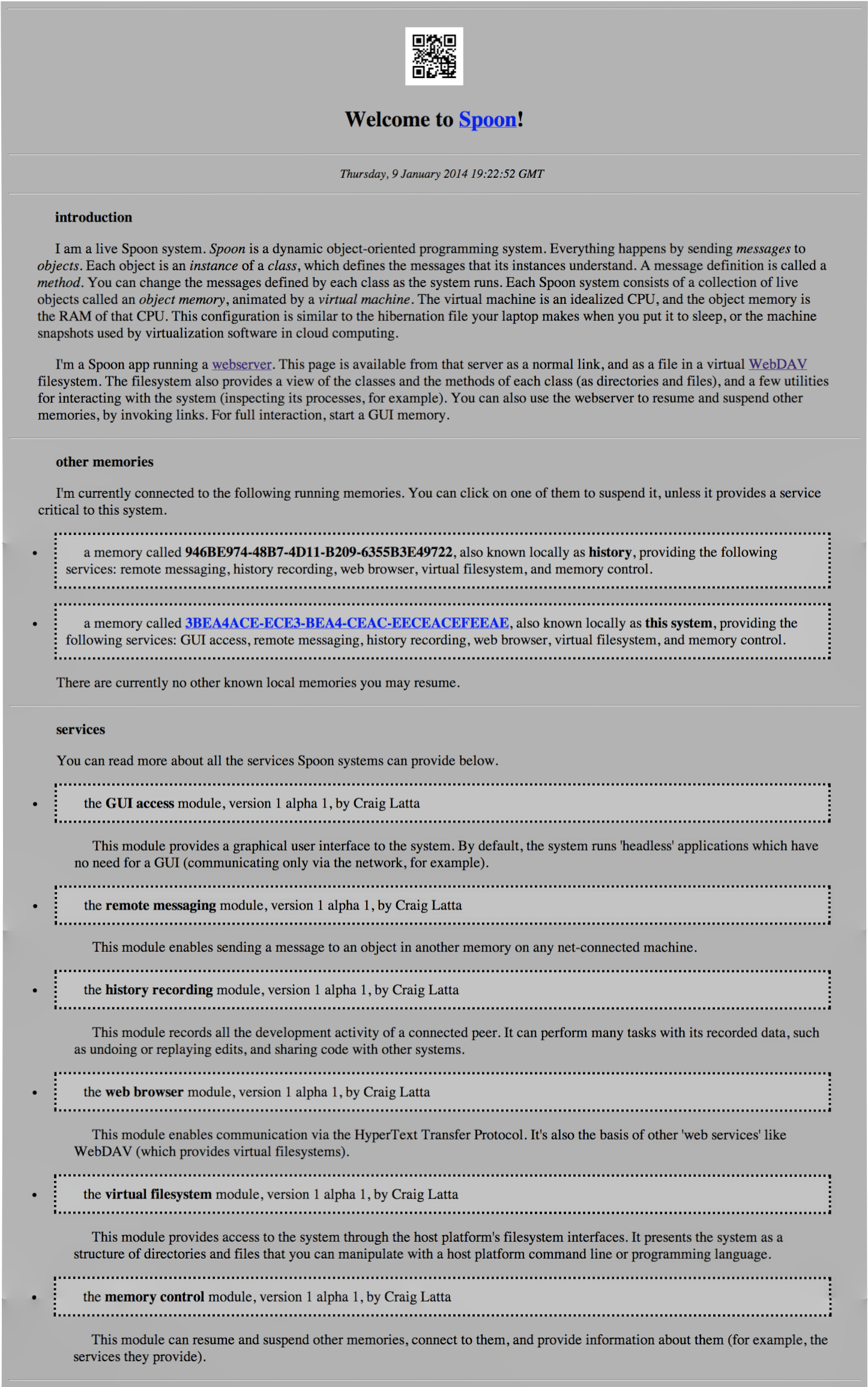
the initial Spoon webpage
A Spoonful of Raspberry Pi
Posted in consulting, Naiad, Smalltalk, Spoon with tags Flow, Morphic, MVC, naiad, Raspberry Pi, remote messaging, smalltalk, spoon, squeak, virtual machine on 3 January 2014 by Craig Latta
Spoon is up on the Raspberry Pi and exchanging remote messages with Spoon on my laptop. Morphic works, but it’s pretty slow, so I’ll be sticking with MVC for now (the Raspberry Pi is a 700MHz machine… I’m looking forward to Tim’s profiling work!). I’m writing a talk for FOSDEM in February called “A Spoonful of Raspberry Pi”. What should the Pi do? I’m eager to hear your suggestions!
Another VM debugging trick: halting
Posted in consulting, Smalltalk, Spoon with tags debugging, smalltalk, spoon, squeak, virtual machine on 31 December 2013 by Craig LattaJust another little VM debugging trick I use… In one of my VM plugins I include a little C function called “breakHere”, which Smalltalk can call as a primitive. I put a breakpoint on it in the C debugger, and then have a convenient way to break in the C debugger from Smalltalk.
What services should the initial Context filesystem provide?
Posted in Context, Naiad, Smalltalk, Spoon with tags context, minimal, modules, remote browsing, smalltalk, spoon, squeak, virtual filesystem, webdav on 19 December 2013 by Craig LattaThe Context app is now mountable as a virtual (WebDAV) filesystem. What should it do? It has a file at the top level called “README.html”, which is obvious enough. What should the README describe? What would you want a newcomer to be able to do from their favorite text editor (or their favorite file-aware programming language)? Browse classes and methods? Resume and suspend object memories? Add and remove code modules? Please share your thoughts, keeping in mind that this is meant to be a minimal system (one can always add code modules to it later).

VM debugging trick: browsing object memory snapshots made from the C debugger in the simulator
Posted in Smalltalk, Spoon with tags C debugger, debugging, smalltalk, snapshot, spoon, squeak, virtual machine on 17 December 2013 by Craig LattaRecently I made use of a virtual machine debugging trick that I don’t think I’ve written about here. The virtual machine simulator is a great way to browse around the state of object memory at the point of a VM crash, but it’s relatively slow (I measured it at about 3,000 instructions per second in my sonification work). The time it takes to get to that point might be prohibitively long.
Instead, you can run to that point in the C debugger (I use lldb on Mac OS), and make a snapshot by invoking primitiveSnapshot() manually. Then, open a simulator on that snapshot and browse the objects to your heart’s content. Depending on the error, you might even be able to modify the objects such that the active process may proceed, and you can snapshot a repaired object memory from the simulator.
 thisContext